
Trace Putnam County Former Owners Through Each Transfer
Begin with the most recent deed tied to the parcel. Treat every prior-deed reference in that instrument as a possible bridge to the next owner. One caution applies here. This example structure is a research log, not a claim about a specific Putnam County tract, so fill it only from the deed image and its citations.
| Transfer date | Grantor to grantee | Deed type | Book/page |
|---|---|---|---|
| Newest verified date | Prior owner to present grantee | Exact recorded type | Current citation |
| Earlier verified date | Earlier grantor to later grantor | Exact recorded type | Prior citation |
| Next earlier date | Earlier party to the next link | Exact recorded type | Older citation |
Every row must describe the same land. Check district, lot, acreage, road, plat, adjoining-owner calls, and prior references before any former owner joins the sequence.
Putnam County's Deed Sources Cover Different Eras
Putnam County's deed sources span different eras. Knowing which system covers which years saves real time. The Putnam Clerk's Real Estate page reports deeds from 1810. It also lists historical index books from 1806 through 1833. Its online images reach into the early 1800s. The local Kofile index covers historical material from 1806 through 1936. The GSCCAA statewide real-estate name form, at the other end of the timeline, displays coverage beginning January 1, 1990. Those dates describe separate access systems, not one universal cutoff. A gap in one portal does not mean a deed went unrecorded. Take the last good citation in hand. Then move to the local historical index, the courthouse records room, or archival fallback sources.
Know the cutoff. GSCCCA's displayed name-search interval begins in 1990, while Putnam's local deed and index routes reach the early 1800s.
Putnam's Historical Index Books Reach to 1806
The historical index is a genuine advantage for former-owner research in Putnam County. Use it when the modern statewide interval ends. Then copy the index entry's party spelling, book, page, record type, and date exactly. Early deeds may describe land through district, land lot, acreage, roads, streams, or adjoining owners rather than a present street address. Expect older language. The GSCCCA book/page form retrieves an already known citation. You search by county, book type, book, and page. The official form's fields show why book/page is the most efficient handoff. It links a deed image, an index entry, and courthouse help.
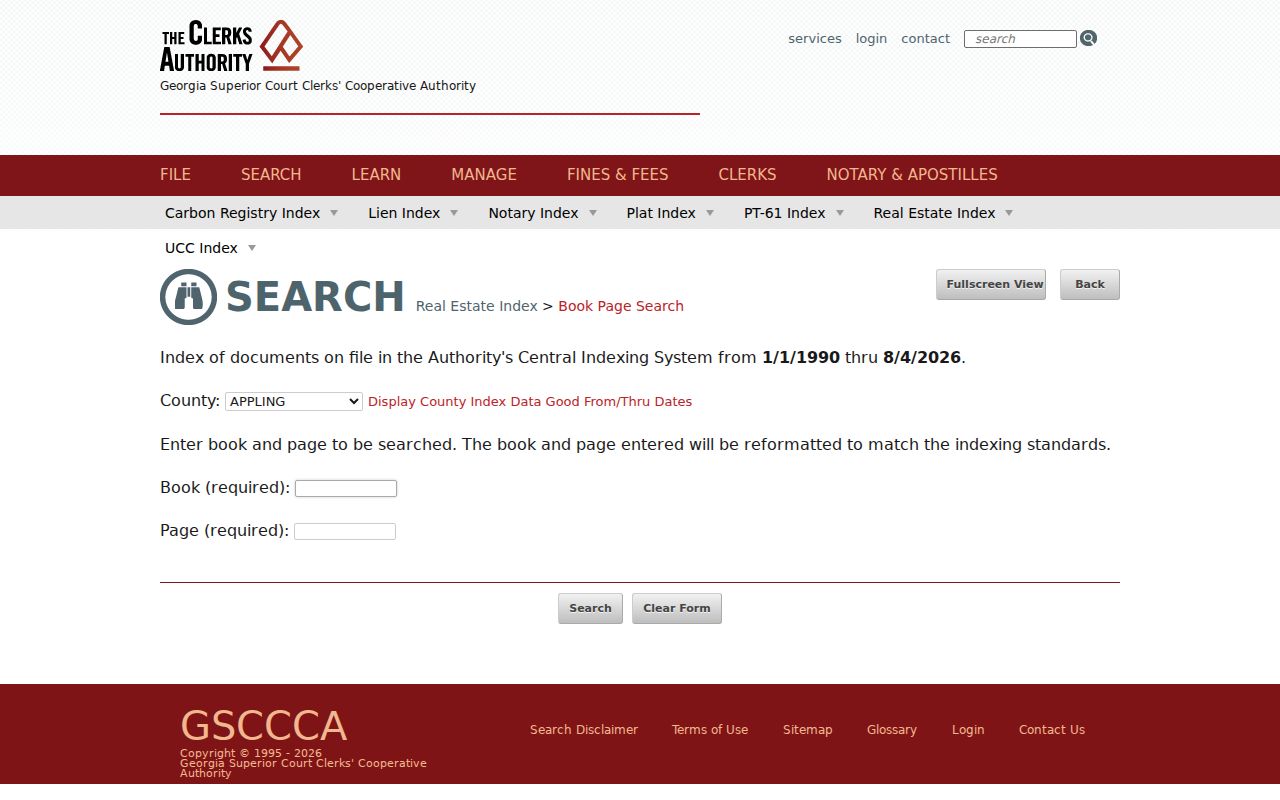
The image is a search interface, not a former-owner list. Use its result to inspect the instrument itself and confirm the legal description stays continuous.
Walk the Putnam County Chain Backward
Reconstruct previous owners in reverse. Start from a known current citation, read the conveyance, then turn the grantor into the grantee search for the next older acquisition.
- Find the current acquisition deed with the current owner or parcel reference.
- Read the grantor, legal description, prior-deed citation, deed type, and both relevant dates.
- Search that grantor as a grantee in an earlier interval, including spelling and capacity variants.
- Repeat only after the land description matches, then shift to historical index books when the online interval ends.
- Grantor and grantee
- The conveying party and the receiving party named in an instrument.
- Chain of title
- The linked sequence of recorded transfers for the same land.
- Reverse index
- An index used to locate a party in the opposite grantor or grantee role.
- Warranty and quitclaim deeds
- Different forms of conveyance whose legal effect must be read from the instrument.
Legal Descriptions Keep Putnam County Prior Owners Together
Names alone create false chains. A former owner may have conveyed several Putnam County tracts. Two people can easily share a surname or initials. Compare district and land lot, acreage, and road or water calls at every step of the walk. Check lot and block, recorded plat, and adjoining owners as well. A street address can change or may never appear in an early deed at all. The legal description and the prior-deed reference are the real continuity tests. Where a deed cites a plat, retrieve that plat separately. Then compare the lot or tract designation.
Estates and Trustees Can Break a Simple Putnam Chain
A prior owner may next appear in the deed records under a changed label. That label may be an estate, executor, administrator, trustee, spouse, or entity rather than a plain name. Search exact names, initials, and married-name variants. Search the estate name and the representative's capacity in both party directions. Then inspect any court order or authority the deed references. Keep the capacity words in your citation. They explain why the grantor name changed. They can also distinguish a genuine transfer from a mere name match. An LLC in the chain adds its own wrinkle. The Georgia Secretary of State entity search may reconcile its exact name and control number, but the deed itself remains the parcel evidence that matters.
Security Deeds Are Not Putnam County Former Owners
Georgia deed indexes can include security deeds, assignments, cancellations, releases, liens, and related filings. A lender or assignee in one of those records is not a former owner. Keep such names out of the ownership chain. Classify the instrument before adding a row. Tax-sale and estate sequences can also take more than one record to understand. Preserve the deed, fi fa, redemption clue, release or cancellation, and any linked court matter. Do not shrink the event to a single owner change.
Putnam County's Offline Handoff Extends the Search
When the digital trail stops, the courthouse Deeds/Records Room offers a public terminal. The fee is $5 per four hours. Take along the last verified book/page. Include the prior-owner name, a land district or lot, a legal-description phrase, and a target year. That packet gives staff or a hired researcher a precise starting point, though the Clerk will not conduct legal research. Putnam County offers other support as well. The Eatonton-Putnam Library's Heritage Genealogy Room may supply address history, family clues, maps, or notices. The Eatonton-Putnam Historical Society archive and Georgia Archives microfilm can help too. The Virtual Vault resources and local newspaper collections are also worth a look. Confirm every clue in the deed or plat record before adding it to the chain.
How Far Back Putnam County Former Owners Can Be Traced
Putnam County property records reach remarkably deep. Historical index books open in 1806, and deed images follow starting in 1810. That reach still comes with caveats. Not every parcel has an unbroken online chain. A modern lot rarely matches its original parent tract. Subdivisions, splits, combinations, road changes, and rewritten legal descriptions can all break the line. When that happens, plats carry the story forward. The deeds of earlier parent tracts carry it the rest of the way.
Keep verified links in your notes and flag any gap you cannot resolve. The historical society holds two centuries of local archive material. The library's newspaper collections add texture to a house history. Neither substitutes for recorded proof. For copies of a single document, the Putnam County deed records guide is the right stop. For today's published owner of record, turn to the current owner guide instead.
Keep claims narrow. Former-owner research supports house history, estate work, and property diligence. It is not a title opinion and must never be used to target or harass anyone.