
Fields Inside Putnam County Property Tax Records
Putnam County property tax records pull together what the assessor valued. They also show which exemptions applied, and what the Tax Commissioner billed. A search usually starts with an address or parcel number. Keep the year attached to every number you find. The digest date can lag a recent closing. A paid bill, meanwhile, proves nothing about title. For a fuller picture, search Putnam County property tax records alongside the assessor card. Add the annual notice, the current bill, and any recorded lien or release.
| Field | What It Shows | Where |
|---|---|---|
| Fair-market value | Assessor's estimate of full value for the digest | Board of Assessors |
| Assessed value | Georgia's taxable starting point, generally 40% of fair-market value | Board of Assessors |
| Exemptions | Approved reductions that lead to net assessed value | Assessor and Tax Commissioner |
| Bill and payment status | Amount billed, balance, and collection status | Tax Commissioner |
| Millage | Annual levy applied to taxable value | Tax notice and bill |
A sale price marks one transaction. Fair-market value is the assessor's yearly estimate. The assessed or net assessed figure is what the tax math actually uses. Three different numbers can sit on one parcel card without anything being wrong.
Save each card and bill with its year showing. Construction can move improvement value. Land value can shift on its own. An exemption changes taxable value without touching fair-market value. Compare the same field across years. Note any change in the property, the exemption status, or the taxing district.
Send Putnam County Value and Bill Questions to Different Offices
Putnam County splits property tax work between two offices. The Tax Assessor, at 706-485-6376, handles valuation and digest information. The Tax Commissioner, at 706-485-5441, handles bills and payments. That office also handles exemptions administration, delinquency, fi fas, and tax sales. The assessor's qPublic landing page notes that its values reflect the most current published digest. It sends bill questions to the Tax Commissioner.
That division matters after a recent closing. Georgia's real-estate tax record uses January 1 ownership and value status. A deed recorded later can be newer. It may postdate the owner line displayed for that digest year.
The January 1 rule also explains a common split. A current bill and today's owner search can tell different time stories. Track the tax year, the bill mailing date, and the deed recording date. For who presently holds title, rely on the newest deed. For who was responsible within a particular digest, rely on the dated tax material. Ask the office how it treats that transfer.
Follow Putnam County's Current Tax-Card Path
Begin on the official assessor page and take its qPublic link, which routes to Schneider Beacon. The portal does not display the live parcel card to every visitor, so field labels vary. Copy only what the card actually shows, such as parcel number, situs, owner line, fair-market and assessed values, exemptions, sale history, acreage, and tax year.
| Search key | Best use | Check before relying |
|---|---|---|
| Address | Find a known site | Try road abbreviations and directionals |
| Owner name | Find parcels on the digest | Try initials, entity names, and variants |
| Parcel or map number | Cross-reference GIS, deed, and bill | Preserve punctuation and leading zeros |
Note: A portal that will not load is a reason to call the assessor, not a reason to borrow unverified fields from another county.
Look Up a Putnam County Tax Bill
The Tax Commissioner's property page links the online payment service, though its bill-search fields sit downstream of that link. Have the parcel number and address from the assessor or GIS record in hand. If the portal will not return the year you need, call the office or email PCTC117@Yahoo.com.
- Identify the parcel through the assessor record or official GIS viewer.
- Open the Tax Commissioner property page and select the relevant tax year.
- Record billed amount, balance, payment status, millage context, and exemptions shown.
- For delinquency, check the recorded fi fa and any later release, tax-sale deed, or redemption evidence.
- Assessed value
- The statutory fraction of fair-market value used before exemptions and millage.
- Mill rate
- Tax per $1,000 of taxable assessed value.
- Homestead exemption
- An approved reduction associated with an eligible owner-occupied home.
- Tax lien or fi fa
- A recorded claim tied to unpaid property tax, requiring later-release checks.
Read Putnam County's 40 Percent Assessment Math
Georgia generally assesses taxable real property at 40 percent of fair-market value. Picture a fair-market value of $250,000. The gross assessed value would be $100,000 before exemptions. Subtract any approved exemptions to get net assessed value, then apply the millage rate. The illustration shows the arithmetic only, not a Putnam County parcel estimate.
For scale, the county's 2025 notice reported a $3.196 billion gross digest and a $2.560 billion net digest. It also set a net maintenance-and-operations rate of 6.001 mills. Those countywide totals set the fiscal picture. They cannot pin down a single bill. Taxing districts and exemptions vary parcel by parcel.
Check Putnam County Homestead and Senior Relief
The county's tax guidance names April 1 as a key filing date. It outlines homestead relief, age-based relief, and an age-70 provision. Rules and forms change. So confirm the current application through the Tax Commissioner's FAQ or the office itself. Never carry an exemption from one bill to a different owner or year.
Keep dated copies of the application, the approval or denial, the annual assessment notice, and the bill. Those papers separate a valuation dispute from an exemption-processing problem.
Eligibility never follows from age or occupancy details alone. Ask which proof and filing method the office requires. Learn whether an exemption renews automatically or needs a new filing after a transfer. A denial can feed into the local equalization appeal route. So save the denial and its date.
Distinguish Putnam County Delinquency, Fi Fas, and Tax Sales
Under the local FAQ, ordinary bills go out by October 1. They come due December 1. A delinquent balance can accrue interest and penalties and produce a recorded fi fa. A tax sale is a later stage, not proof that title questions are settled. Trace the notice and the recorded tax deed. Then check redemption clues, cancellations or releases, and any later conveyance.
Tax-sale caution. A short sale-status label is not enough to resolve current ownership; inspect the recorded instruments and obtain professional advice for a high-consequence decision.
Build the delinquency file around the parcel and its legal description. A clean worksheet lists the original bill, the fi fa recording, and any levy or sale notice. Add the tax deed, redemption proof, and a release or cancellation. Later court filings belong on the list too. Watch for one trap. A payment screen can show a zero balance. An older recorded instrument can still need a release check.
Date Putnam County Digest and Sales-Ratio Notices
Putnam County's 2024 sales ratio came in at 40.01, just above the 40.00 state benchmark, according to a county notice dated August 19, 2026. That number is a countywide equalization measure. It does not mean every parcel was valued at the same ratio. A second notice, dated August 20, 2026, said the 2026 digest and millage process was underway. The rate was scheduled to be set September 4, 2026. Check the county news feed for the final notice before quoting any current millage rate.
Recognize Putnam County's Official Tax Pages
The county assessor page identifies the valuation office and its official links.
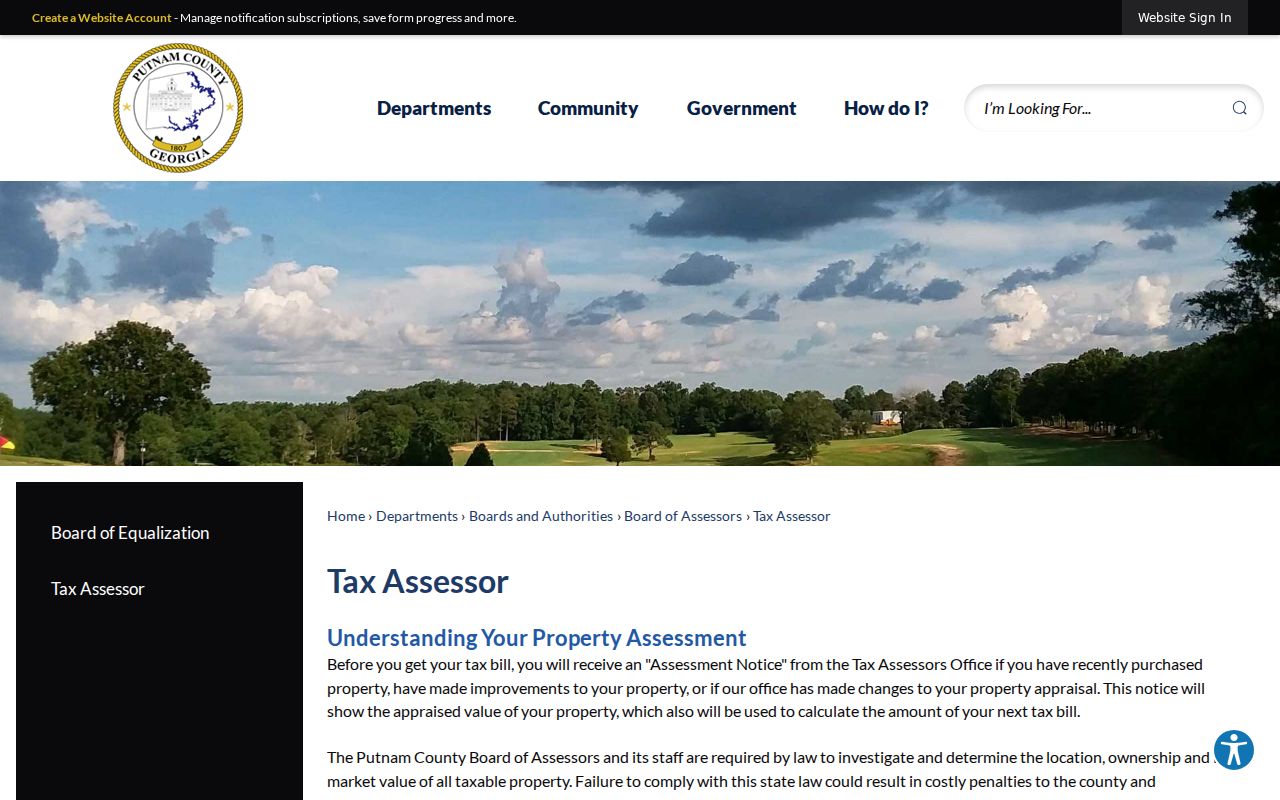
Start with the published digest and assessment contacts. Keep value questions separate from billing. For billing and collection, the Tax Commissioner property page is the official route.

That page confirms the right office even when a payment form will not open. The property-tax FAQ covers local timing and responsibility rules.
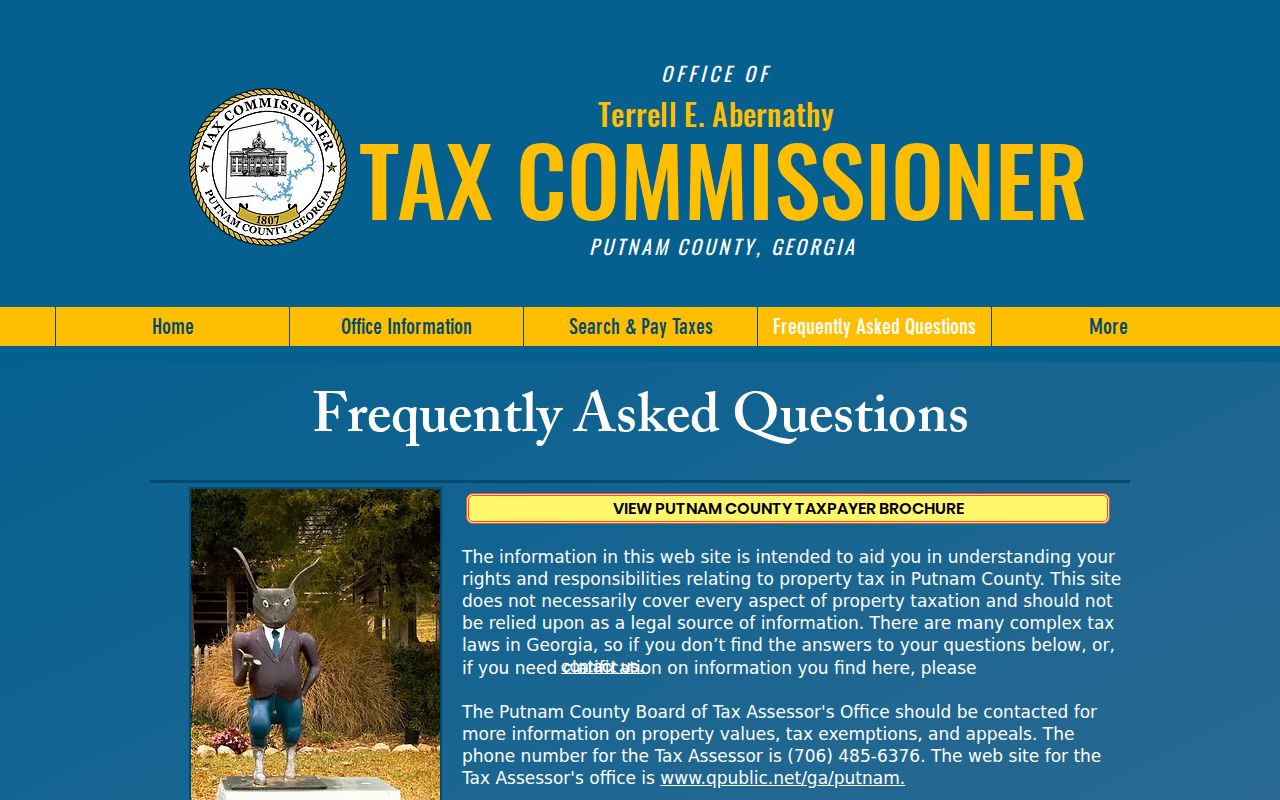
Check the FAQ for current mailing, due-date, exemption, and delinquency guidance before relying on any older summary. For contested values, the Board of Equalization page identifies the local hearing route.
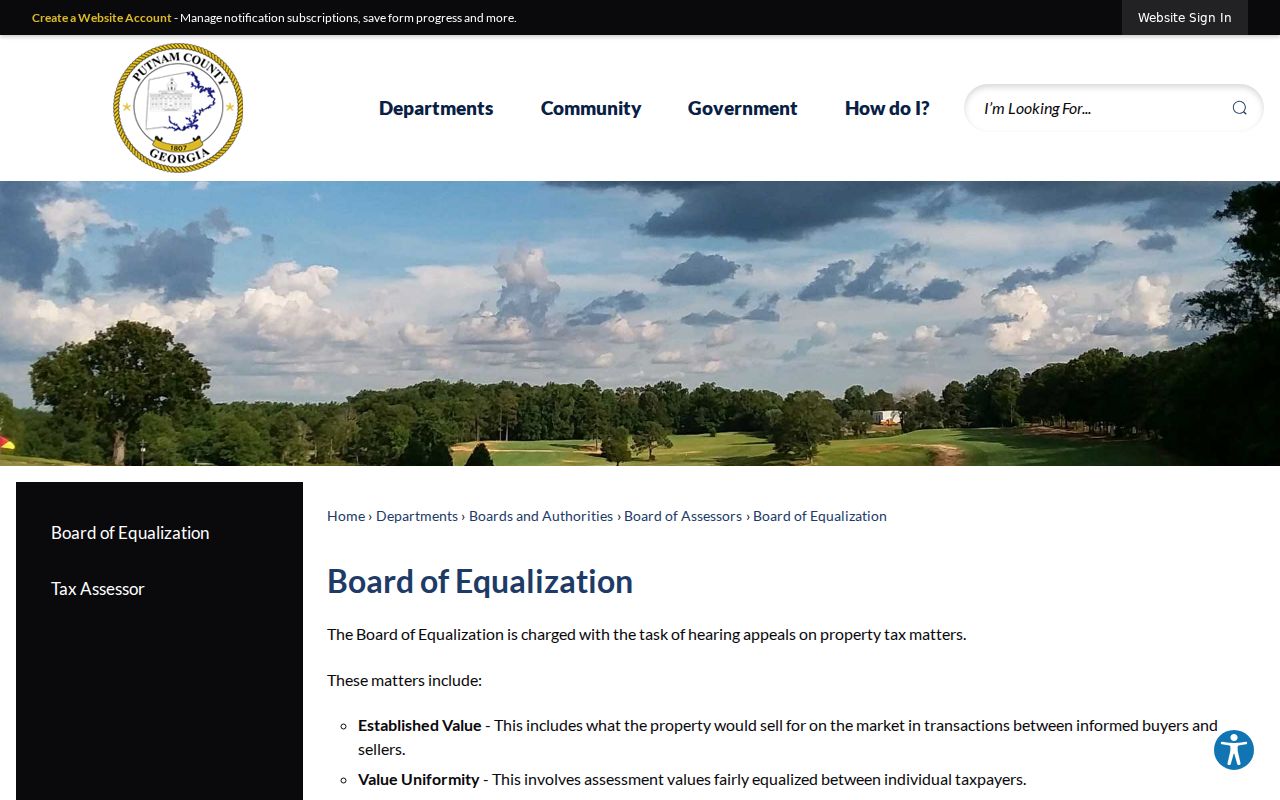
File the Board page with the appeal record. It belongs beside the assessment notice and filing proof, not in the tax-payment file.
Challenge a Putnam County Assessment
Putnam County owners can appeal their assessments through a set path. A owner of record may declare a proposed value between January 1 and April 1 under O.C.G.A. §48-5-9. The annual assessment notice arrives each year. Once it does, an appeal goes to the Board of Assessors. It generally must be filed within 45 days. From there, the route runs to the Board of Equalization or arbitration. Superior Court comes next when applicable. The Putnam Board of Equalization hears disputes over value, uniformity, taxability, and homestead denials. It also handles denials of special assessments.
Appeal window. Use the deadline printed on the assessment notice; the local framework gives 45 days, and missing it can close the ordinary appeal route for that notice.
Strong evidence starts with the dated parcel card and assessment notice. Add photographs, comparable sales, deed history, and any factual correction to acreage or improvements. A GIS outline helps locate the land but is not a survey. An agency-held document may not be otherwise available. In that case, Putnam's NextRequest portal is the Georgia Open Records Act fallback for a narrowly described existing record.
Organize comparable sales by sale date, location, parcel characteristics, and source citation. Do not just list them raw. State factual errors separately from opinions about value. The Board of Equalization can weigh uniformity and taxability along with value. Boundary measurement belongs with a surveyor. Title questions belong with recorded instruments or counsel.
Save the submission confirmation and every later notice. The record may get corrected. Compare the revised fair-market, assessed, exempt, and net assessed figures against the original. Do not assume the bill changed automatically. Ask the Tax Commissioner when a valuation decision flows into billing. Also ask whether a refund or adjusted balance requires a separate step.