
Find Out Who Owns a Putnam County Parcel
Pin down the parcel before you read any name. That habit prevents most errors. Putnam County keeps assessment, mapping, and deed records in separate systems. Each result deserves a cross-check against the next. Start with an address, note the parcel number and the date of every result. Then finish at the newest recorded conveyance. The owner in one source should match the story told elsewhere.
- Enter the address in the official Putnam County Parcel Viewer, whose search prompt accepts address, parcel, or owner.
- Carry the selected parcel number to the Putnam qPublic route and read the current published tax-digest owner.
- Search that exact name as grantee and grantor in the GSCCCA real-estate name index, then inspect the newest relevant deed.
- Compare the deed's legal description and prior-deed reference with the parcel, not merely the spelling of the party name.
This route names the owner cleanly. It also leaves a clear trail. A recent closing may lag behind the published digest, so the recorded deed can be newer than the assessor's result.
Putnam County Starts With the Parcel, Not the Person
A name search alone invites trouble. It can blend people who share initials. Former owners, lenders, and parties who signed in a representative role can get mixed in too. Putnam County's Parcel Viewer lowers that risk. It anchors the inquiry to a mapped polygon and a parcel identifier. Its prompt takes an address, a parcel, or an owner. If the street entry fails, try a normalized street form. Then confirm the point on the map, and write down the selected parcel ID.
Treat the GIS outline as a spatial check, never a survey. Match it against the deed's district, lot, acreage, road, plat, or adjoining-owner language. Only then decide that two similarly named tracts are the same land.
Read Putnam County's Published Owner With a Date
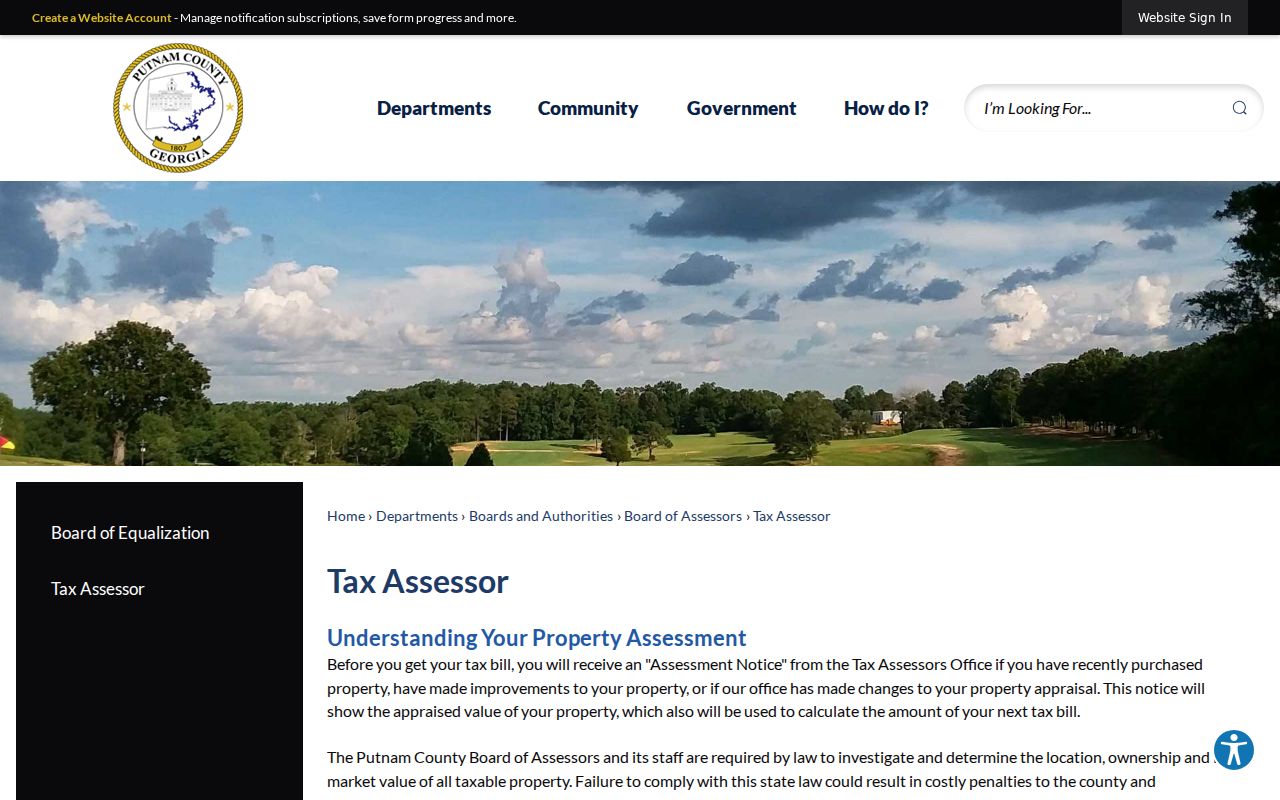
The Putnam County Tax Assessor page links to qPublic, which describes its values as the most current published tax digest. That makes the assessor roll a practical owner snapshot. It is not a live closing feed. The Beacon parcel card is often unavailable, so assume no fixed field layout or refresh interval. The assessor landing page is the county-controlled starting point for the owner route. Use it to begin the search.
Using the county's own qPublic link keeps you on the authorized vendor path rather than a copied or stale owner page. Save what the parcel card shows. Record the card date, owner name as displayed, parcel number, situs, mailing address, value fields, and sale reference. Keep any deed citation with them. A mailing address tells you where notices go. It does not prove who occupies the Putnam County parcel.
Where Putnam County Property Ownership Appears
No single screen settles every ownership question. These official sources build a short evidence chain for anyone asking who owns a Putnam County property.
| Official source | What it contributes | Freshness and access |
|---|---|---|
| Assessor digest | Published owner, mailing and situs context, parcel and value data | Current published digest through the county's qPublic link |
| Clerk and GSCCCA deed index | Grantee, grantor, instrument, book/page, filing and instrument dates | Recorded transaction evidence; image access varies by account tier |
| Georgia Secretary of State | Entity name, control number, registered agent, and officer fields | Supporting identity context, not title proof |
| County Parcel Viewer | Parcel location and the map's linked owner context | Current viewer for geographic cross-checking |
The assessor's owner of record and a deed's grantee can differ after a recent transfer, or because an instrument needs careful reading. The occupant may be someone else entirely. Keep those three ideas apart.
Confirm the Putnam County Owner in the Deed Index
The Clerk's Real Estate Division holds deeds, plats, UCC filings, and lien filings. Search the assessor's name statewide first. Then examine the newest plausible result's deed type, instrument date, filing date, book and page, and legal description. Run the same party as both grantor and grantee. The latest hit may be a security deed or a release rather than a fee transfer.
The GSCCCA name form offers county, party type, name type, last or company name, first name, instrument type, and date range. Its statewide real-estate coverage starts January 1, 1990. Putnam's Clerk and Kofile routes reach back much farther. The right portal depends on the date.
Putnam County LLCs, Trusts, and Estates Need a Second Check
Many parcels vest in an LLC, corporation, trust, estate, trustee, executor, or administrator instead of one person's name. Copy the capacity exactly as recorded. For a business entity, the official Georgia SOS eCorp search accepts Business Name, Control Number, Registered Agent Name, and Officer Name. That result helps reconcile the legal actor named on the deed. It does not prove the entity owns this land. A registered-agent address is not the parcel address. For an estate or trust, inspect the conveyance and any linked probate authority. Never strip the role from the name.
- Owner of record
- The party shown in a defined official record at the time that record was published.
- Grantee
- The party receiving an interest in a recorded conveyance.
- Title
- The legal rights in land, which an index summary alone does not settle.
- Situs address
- The property's physical address, distinct from the owner's mailing address.
When the Putnam County Portals Do Not Answer
The courthouse Deeds/Records Room has a public terminal. Terminal use costs $5 for four hours. The office does no legal research. It also supplies no real-estate forms. For a consequential matter, use the Clerk's e-certification or certified-copy route once you have the correct book and page or instrument. If a portal is down, call the Clerk at 706-485-4501 or visit the Real Estate Division at the courthouse. Existing county records can also be requested through Putnam NextRequest under the Georgia Open Records Act. Describe your request by parcel, date range, record type, and known citation. Ask for records, not research.
Note: Georgia agencies generally respond within three business days or provide timing, cost, and any legal basis for withholding.
Filing Alerts Protect a Putnam County Owner's Name
GSCCCA offers a free service called the Filing Activity Notification System, known as FANS. It sends a notice whenever a filing matches a personal or business name. It also matches a property address someone has registered. Once a Putnam County property owner of record has been identified, this tool earns its keep. A surprise alert about a deed or lien can be the first hint that something is off. That deserves a closer look at the actual instrument.
An alert by itself proves nothing about fraud, ownership, or a valid transfer. Pull the indexed document. Compare the party names and legal description. Contact the Clerk when a match seems off. The service supplements regular deed records checks. It does not block a filing, and it cannot replace title monitoring by a qualified professional.
Limits on Who Owns This Property Results in Putnam County
A public tax roll has real limits. It may name an owner of record. Yet it says nothing reliable about who actually lives there, who benefits behind a trust, or whether an unrecorded claim exists. It also cannot settle the legal effect of liens and easements. Georgia's Safe at Home program and certain statutory exemptions shield qualifying address information from disclosure. A suppressed field is not an invitation. It is not a cue to rebuild a protected address from other property records.
Use the result with care. An assessor name is not a title search, and ownership may sit in an LLC, trust, or estate. Use Putnam County records for lawful property diligence, never to stalk, harass, or harm anyone.
For detail on the present owner of record, see the Putnam County current owner guide. To reconstruct older transfers, the former owners guide traces the chain of title backward through the deed records.